
How to Negotiate a UK Dental Associate Contract: Before and After You Sign
Negotiating an associate contract is not confrontational, and it is not optional if you want to be paid fairly. Every reputable practice expects a well-prepared dentist to push back on the first draft. In 2026, with practice costs at record highs and associate percentages under pressure, negotiation is where the real difference in your income and working life gets made. This guide sets out what to push on before you sign and how to revisit terms afterwards, drawing on British Dental Association guidance, the current market and how UK courts have treated the clauses that most often catch dentists out.
Two things are true at the same time. Practice owners are under real cost pressure, so an unreasonable ask can end a conversation early. And the small print is often drafted more generously to the practice than the market requires, so a well-argued ask lands more often than most dentists expect. The right approach is to know the levers, prioritise the two or three that matter most for your situation, and be ready to justify each one with evidence.
Key summary at a glance
UK associate agreements are typically built on the BDA model contract, the DPA model contract, or a corporate or ADG-derivative agreement used by the larger groups, with bespoke drafting on top.
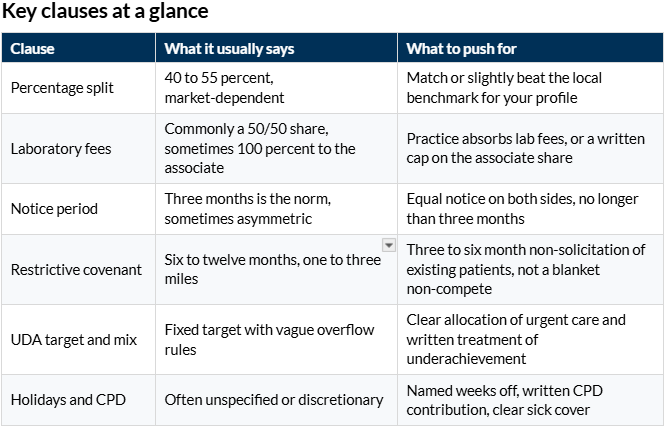
The seven core levers to negotiate are: percentage split, laboratory fee arrangement, materials and consumables, UDA target and NHS or private mix, notice period, holidays and CPD, and restrictive covenants.
Leading UK dental solicitors treat restrictive covenants beyond six months as unduly prohibitive. Three to six months is the range that stands the best chance of holding, and twelve months is very unlikely to be upheld. Radius is typically one to three miles in urban areas, three to five miles in rural areas.
Three months is the industry norm for notice, on both sides. Shorter periods are usually reserved for probation. Anything asymmetric or longer than three months on the associate side is worth pushing back on.
The NHS annual pay uplift does not automatically pass through to associates. It has to be negotiated separately with the practice owner.
BDA members can have any associate agreement reviewed under the BDA associate contract review service, delivered by the BDA advisory team and included in the membership.
From April 2026, the England NHS reform introduced an 8.2 percent unscheduled care requirement, so NHS and mixed associate agreements need to spell out how urgent care is allocated and paid.
Know your starting point
Before you engage with the specifics, know what you are looking at. Most UK associate agreements in 2026 fall into a handful of families: the BDA model contract, the DPA model contract, corporate or Association of Dental Groups (ADG) derivative agreements used by the larger groups, and bespoke documents drafted by the practice or its solicitors. The BDA and DPA models are broadly balanced and widely accepted. A corporate or bespoke contract can be perfectly fair, but it can also introduce clauses that push further than the model contracts do, so it deserves closer reading.
The BDA offers a dedicated associate contract review service delivered by its advisory team. For members, that review is included in the subscription. It is one of the highest-return uses of BDA membership, particularly for anyone taking on their first associateship or moving to a bespoke document. If you are not a BDA member, a specialist dental solicitor can do the same review, typically for a few hundred pounds, which is a small fraction of the value at stake in a full-time contract.
Where you sit in the market matters. A dentist bringing a private book of patients negotiates from a different position than a foundation-year graduate. An experienced associate with strong retention negotiates from a different position than a locum filling a short-term gap. In every case, the practice already knows what it can offer someone with your profile. So do you, if you have looked at three or four comparable roles first. Homework is the cheapest form of leverage.

The main levers to negotiate before you sign
Seven items deserve careful thought before you sign. The first six are covered here. Restrictive covenants sit alongside them in importance and get their own section next.
The percentage split
The headline percentage is where every negotiation starts, but it is not always where the biggest gains are. Corporates and lower-cost regional markets are more commonly offering 40 to 45 percent in 2026, many independents still hold 45 to 50 percent as their base, and stronger markets such as London and the South East continue to see 45 to 55 percent for experienced dentists or specialists. If your target percentage is a few points above the offer, and you can point to comparable roles, ask for it. If it is materially above, expect a trade elsewhere: a slightly higher percentage in exchange for a longer notice period, a broader covenant or a stricter UDA target is a fair conversation to have.
The laboratory fee arrangement
Laboratory fees can matter more than the headline percentage on a lab-heavy book of work. The three common structures are: a 50/50 split between practice and associate, the associate bearing the full lab bill on their cases, or the practice absorbing the whole lab cost. On crown-and-bridge or dentures-heavy work, the difference between 50/50 and full absorption can be worth several thousand pounds a year. Ask which arrangement is in the contract, ask what happens if lab costs rise mid-year, and ask whether the practice has ever pushed the lab bill back to associates as a result of cost pressures. Written answers are worth more than verbal ones.
Materials and consumables
Increasingly, materials and single-use consumables that used to sit as a practice cost are being pushed to the associate. This is one of the quieter shifts of the last two years. Ask which materials are covered by the practice, which are not, and how any grey-area items such as impression materials, endodontic files, matrix bands and digital scan warranties are treated. A one-line clarification in the contract is worth years of confused Friday-afternoon arguments.
UDA target and NHS or private mix
For NHS and mixed roles, the UDA target and the mix of NHS to private work is a live number. Typical full-time UDA targets sit in the 5,000 to 7,000 range. From April 2026, the England NHS reform introduced an 8.2 percent unscheduled care requirement, so associate contracts now need to spell out how urgent care is allocated between clinicians and how the flat £75 per course of treatment is shared. If that language is not in the contract in front of you, ask for it before you sign. A vague clause becomes an expensive dispute after twelve months.
Notice period
Three months is the industry norm for notice, on both sides, with shorter periods usually reserved for probation. Longer than three months on the associate side, particularly with no reciprocal notice on the practice side, is worth pushing back on. If you are a specialist or a partner in an established referral relationship, a longer notice may be reasonable, but should always be mutual. A very short notice period from the practice can also be a red flag: it usually indicates the practice wants to keep the option to move quickly on you.
Holidays, CPD, indemnity, sick leave and maternity
Associate contracts are self-employed, so statutory holiday and sick pay do not apply, but any decent contract will still address these items. Ask how many weeks the practice is comfortable with you being away, whether the practice contributes to your CPD budget, how sick cover is arranged and paid, and what happens on maternity or paternity leave. Some practices offer nothing on these lines. Others offer a small CPD contribution or a discretionary period of paid absence. The presence or absence of these terms tells you a lot about the practice's culture.
Restrictive covenants and post-termination clauses
Restrictive covenants sit in a class of their own because they follow you after you leave. Under English law, they are treated as restraint of trade, which means they are prima facie void unless the practice can show a legitimate business interest and that the restriction goes no further than necessary. The most important practical point is that a UK court will not add words or rewrite an overbroad covenant. Following Tillman v Egon Zehnder Ltd [2019] UKSC 32, a court may sever, or 'blue-pencil', an offending part of a clause where the offending wording can be cleanly removed without changing the rest of the contract. Where it cannot be cleanly severed, the whole covenant is struck out, as the BDA guidance on restrictive covenants and multiple dental law firms confirm.
In practice, overreaching covenants often fail. A five-mile, three-year non-compete for a general associate is unlikely to be enforced. A one-mile, six-month non-solicitation of the practice's existing patients is a very different proposition and is more likely to hold. Leading UK dental solicitors treat anything over six months as unduly prohibitive, with three to six months being the range that stands the best chance of holding, and twelve months very unlikely to be upheld. On scope, the practical benchmarks are: one to three miles of radius in urban settings (sometimes narrower in dense city centres), three to five miles in rural areas, and a limit to soliciting or treating existing patients rather than a blanket ban on practising dentistry.
When you see a covenant that reads well beyond these benchmarks, do not accept it on the basis that a court would strike it out or blue-pencil parts of it. That leaves you exposed to injunction proceedings and the legal cost of defending them. Instead, ask for it to be narrowed in writing. Distinguish between non-solicitation, a softer promise not to actively pursue the practice's patients, and non-compete, a broader promise not to practise nearby at all. Both are common. Non-solicitation is easier to accept because it does not stop you from working.
Two other post-termination clauses deserve a look. Retention clauses allow the practice to hold back a portion of your fees for a period after you leave, to cover potential remedial work. These can be reasonable if the amount and the release date are clear, and unreasonable if the practice can hold indefinitely at its discretion. Broad indemnities that make you liable for the practice's losses beyond your own clinical work also need scrutiny. If either clause is drafted widely, ask for it to be tied to specific, evidenced circumstances.
After you sign
Signing an associate contract is a starting point, not a ceiling. Most associate agreements are renewed or reviewed annually, and even if yours does not have a fixed review point, you can raise a conversation whenever the facts on the ground have changed. The most common triggers are: production materially above target, a new referral service you have built, patient retention that stands out, the annual NHS pay uplift, and evidence that the local market has shifted.
The NHS annual pay uplift is worth calling out specifically. Practice owners receive an uplift each year, but it does not automatically pass through to the associate percentage or the per-UDA rate. The BDA has been clear that this needs to be negotiated separately, and it has published guidance for associates on how to raise the conversation. If the uplift has been implemented and your compensation has not moved, that is a legitimate case to bring.
Approach a mid-contract renegotiation the same way you approached the original. Come with evidence: your production, your retention, the practice's fee changes, the market position for a dentist with your profile. Ask for a specific change, not a general uplift. Be ready to trade. And keep it in writing, so both sides know what has been agreed. If the answer is a firm no on every ask and you have made a fair case, that is useful information too. It tells you whether the contract you are in has room to grow.
Why this matters
|
Example scenario
The following is a worked example. It is not tied to a specific practice or job offer, just a simple illustration of how a real negotiation might play out across the levers described above. Treat it as a template, not a benchmark.
Imagine an experienced associate is offered a role at a mixed practice in the Midlands. The first draft of the contract lists a 42 percent split, a 50/50 laboratory fee share, a UDA target of 6,500, a twelve-month restrictive covenant within five miles, and a three-month notice period. Everything else is standard.
The dentist looks at three comparable roles in the same postcode and finds the going rate for their profile is 45 to 47 percent. They also know their book is lab-heavy on crown and bridge work, and their strongest clinical area is endodontics. Their two priorities are the percentage and the laboratory fee arrangement, and their sensitivity point is the covenant.
Their counter-offer is: 45 percent split with the practice absorbing laboratory fees; UDA target held at 6,500 but with the April 2026 urgent care allocation spelt out in the contract; notice period held at three months on both sides; restrictive covenant reduced to a two-mile, six-month non-solicitation of the practice's existing patients rather than a blanket non-compete.
Two of these will land, one will be traded, and one may be resisted. That is a normal negotiation. What matters is that the dentist has ranked their asks by value, can justify each one with evidence, and knows the final position sits within the bounds of what UK practices and courts already recognise as fair. Everything ends up in writing.
Conclusion
Negotiating an associate contract is not a sign that you distrust the practice. It is a sign that you have read it. In a market where every practice principal is under cost pressure, and where the small print is being pushed in the practice's favour, taking the time to prepare your negotiation before you sign, and to revisit terms as your value grows, is the single largest lever a dentist has on their own income and working life.
Focus on the two or three levers that matter most for your situation. Come with evidence rather than accusation. Get everything in writing. Use the BDA associate contract review service or a specialist dental solicitor to review the final draft. And do not treat a signed contract as fixed. The market moves, your value grows, and the terms should move with them.
If you are looking at private, NHS or mixed dental roles across the UK, the team at Gorilla Jobs UK can help you compare terms across offers, understand where the market sits on a specific clause, and prepare for the conversation with confidence.
Disclaimer: This blog is a general overview and should not be construed as professional legal, financial or medical advice.
Frequently Asked Questions
Do I need a solicitor to review my associate contract?
Not always, but it is a strong idea for a first associateship or any bespoke contract. British Dental Association members can use the BDA associate contract review service, delivered by the BDA advisory team and included in the membership. Non-members can use a specialist dental solicitor, typically for a few hundred pounds. Either way, it is one of the highest-return uses of professional advice you will make.
How long is a fair restrictive covenant?
Leading UK dental solicitors treat anything over six months as unduly prohibitive, with three to six months being the range that stands the best chance of holding. Twelve months is very unlikely to be upheld. Radius is typically one to three miles in urban areas, three to five miles in rural areas. Non-solicitation of existing patients is more likely to hold than a blanket non-compete. Anything materially beyond these benchmarks is worth negotiating down before you sign.
Can I negotiate the percentage after I have signed?
Yes. Most associate agreements are renewed or reviewed annually, and even where they are not, a well-supported mid-contract case can move the number. The right time is when the facts on the ground have changed: production above target, a new referral service, strong patient retention, or a market shift. Come with evidence and a specific ask, not a general complaint.
Does the NHS pay uplift automatically increase my UDA rate?
No. The annual pay uplift is applied to the practice contract value and does not automatically pass through to associates. It needs to be negotiated separately with the practice owner. The BDA is clear on this and has published guidance for associates on how to raise the conversation.
What is a retention clause and should I accept one?
A retention clause allows the practice to hold back a portion of your fees for a period after you leave, to cover any remedial work that turns out to be needed. In principle it is not unreasonable, but the amount held and the release date should be clearly written. Avoid a clause that allows the practice to hold indefinitely at its discretion.
Can I use the BDA to check my contract?
Yes, if you are a BDA member. The BDA runs a dedicated associate contract review service, delivered by its advisory team and included in the membership. For anyone taking on a new associateship or moving to a bespoke document, this is one of the strongest reasons to keep the membership current.
Information Sources
British Dental Association, How to negotiate your associate agreement
British Dental Association, Restrictive covenants in dental associate agreements
British Dental Association, Associate contract review for dentists
British Dental Association, Top tips for competitive associate pay
BDJ Jobs, Associate Agreements: Harsh Terms to Watch Out For
Thorntons Solicitors, Restrictive Covenants in Dental Practices
Carter Bond Solicitors, Escaping Restrictive Covenants: How Dentists Can Regain Their Freedom
NHS England, NHS dentistry: quality and payment reforms contractual guidance